
INVESTING MASTERCLASS
Learn How to Invest in
The Stock Market
This complete step-by-step masterclass takes you from knowing nothing about the stock market to picking stocks and building investment portfolios using the same methods professional analysts use.
Most People Never Learn How to Invest
Think about how most people handle money. They earn their salary, pay their bills, maybe treat themselves a little, and if anything is left, it goes into savings.
Month after month, year after year, the cycle repeats.
- Their only source of income is their job
- Their income only grows if they get a raise
- Savings sit in a bank account earning almost nothing
- Every year, inflation quietly eats away the value of those savings
- Years go by, but financial situation barely changes
- They work for money – but their money never works for them
The real problem isn’t inflation. And it’s not a lack of opportunities either.
The real problem is that most people were never taught what to do with the money they earn. They were never taught how money actually works, how to separate assets from liabilities, or how to use their income to build wealth.
The wealthiest people in the world don’t just earn and spend their money. They invest it so their wealth continues to grow over time.
When you learn how to make your money work for you, your income is no longer static – it compounds and grows year after year.
The Biggest Wealth Machine
Is Right in Front of You
For more than a century, one system has consistently created more wealth than almost anything else in human history – the stock market.
It is where the world’s largest and most successful companies raise capital, reach millions of customers, and generate enormous economic value.
Companies like Apple, Microsoft, Amazon, and Google didn’t become global giants overnight. The stock market helped these businesses expand, grow their revenues, and reach more people around the world. Those who invested grew their money along with them.
The stock market is a system that allows anyone to invest in the most successful companies in the world – and profit from their success.
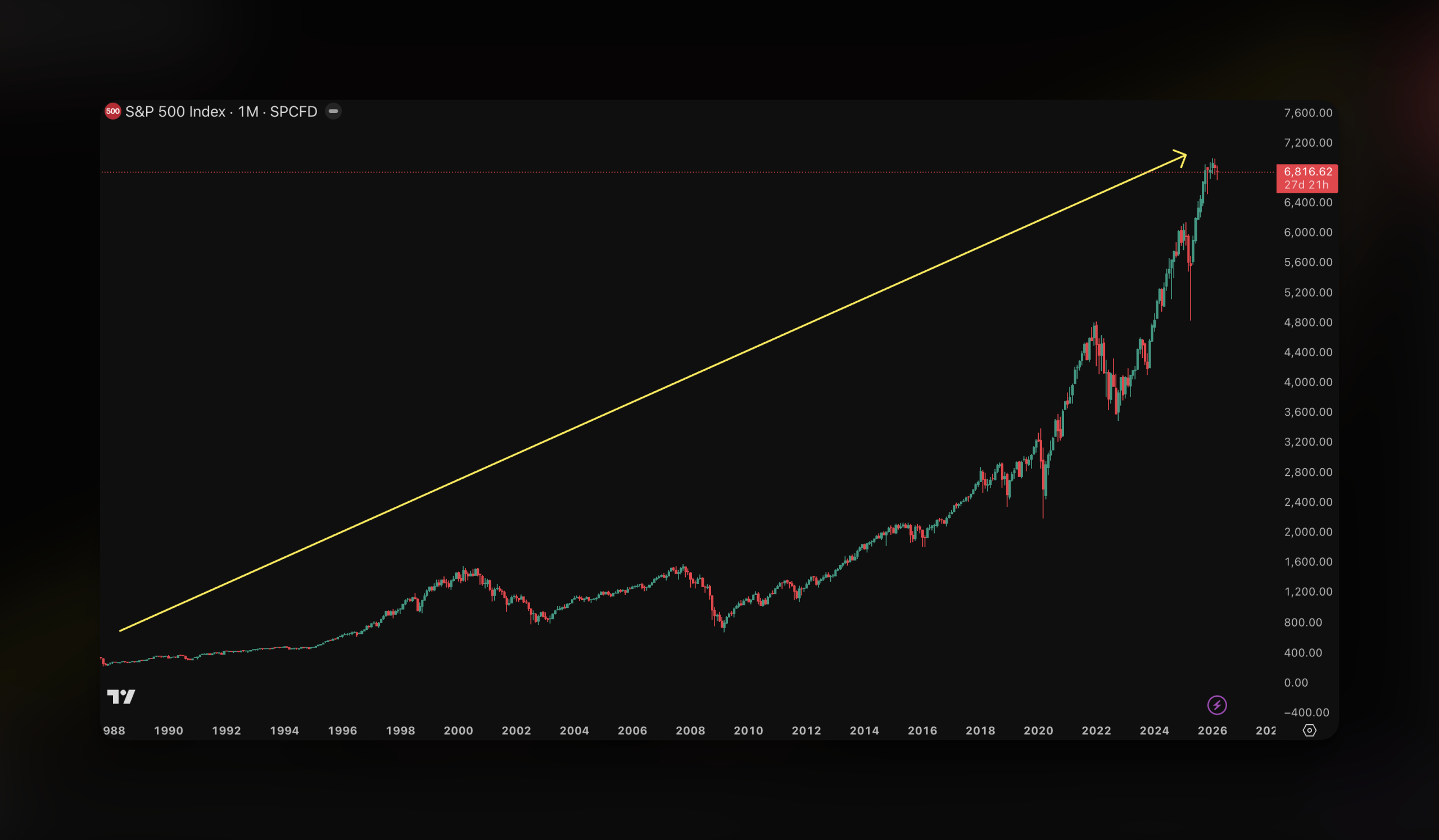
S&P 500 Index – Decades of consistent growth
Stock Market Investing Is
Not a Game of Luck
Even though the stock market has been growing consistently for decades, many people are still afraid to invest in it. Not because the market is too unpredictable – but because they simply don’t understand how it works.
Early humans feared fire. Once they understood how to use it, it became one of our most powerful tools.
When you buy a stock, you’re not placing a bet. You’re buying a small ownership stake in a real company – A company that builds real products, serves real customers, and generates real economic value.
Apple sells iPhones. Microsoft powers businesses around the world. Amazon delivers millions of packages every day. As these companies grow and expand – they generate value for their shareholders.
And by owning shares, you become one of those shareholders.
How Learning to Invest
Can Change Your Life
Your money starts working for you
When you're not investing
Most of your income goes into expenses. You depend entirely on your salary, and when you stop working, the money stops coming.
When you are investing
Your money becomes a tool that helps you earn more – you invest your income so it can grow and generate additional wealth over time.
You earn from the companies you use
When you're not investing
You buy products from companies like Apple and Amazon every day – but the profits go to the investors who own those companies.
When you are investing
Instead of just being a customer, you become a shareholder. As these companies grow and sell more products, your investments grow with them.
Your money stops sitting idle
When you're not investing
Your savings sit in a bank earning 1-2% while inflation eats away 3-5% per year. You’re literally losing money while trying to save it.
When you are investing
You invest your money in assets that grow over time, helping you beat inflation and grow your savings.
You understand what’s happening in the world
When you're not investing
Economic news about inflation, interest rates, or markets crashing feels confusing and creates uncertainty about your financial future.
When you are investing
You understand how such events affect different markets, and know which sectors will get hit and which will benefit.
Market corrections become opportunities
When you're not investing
When markets crash, you assume the economy is collapsing and feel relieved you stayed out of the market.
When you are investing
When markets crash, assets become undervalued. For smart investors, a “market crash” creates an opportunity to generate even higher returns.
You build an additional source of income
When you're not investing
You trade time for money. But there are only 24 hours in a day, so your financial growth quickly reaches its limit.
When you are investing
Your investments work in the background alongside your career, helping you build wealth even when you are not actively working.
You gain a skill that lasts forever
When you're not investing
Your income stays flat and you miss opportunities that could change it simply because you never learned how to recognize them.
When you are investing
You gain a lifelong skill that changes how you think about money and helps you identify opportunities most people don’t even know exist.
Where Others See Problems,
Investors See Opportunities
The same global events that scare regular people often create the biggest opportunities for investors.
- Global pandemic breaks out (COVID - 2020)
Regular Person
“This is terrible. Everything is shutting down and the entire world is going into lockdown.”
Investor
“Vaccines and healthcare products will be in massive demand. Companies like Pfizer and Moderna could see huge growth – time to invest!”
- Inflation rises sharply (2021)
Regular Person
“Everything is getting more expensive. It’s getting hard to survive these days.”
Investor
“High inflation will lead to higher interest rates. I should secure profits on my stocks and move some money into gold .”
- Artificial Intelligence becomes a trend (2022)
Regular Person
“I love ChatGPT. It makes my life so much easier.”
Investor
“AI will reshape businesses, industries and entire economies. Demand for hardware, software, and data centers will surge. This will be the biggest rally of the decade! Time to buy Technology stocks.”
- Bitcoin ETF launch (2023)
Regular Person
“I hear everyone online talking about Bitcoin and crypto. It seems risky… I’ll pass.”
Investor
“Bitcoin ETFs will allow large investment funds to enter the crypto market. If institutional money starts flowing in, demand could explode. I should buy some BTC.”
- Central banks cut interest rates (2024)
Regular Person
“Looks like the economy is improving. At least things might get a little easier now.”
Investor
“Perfect! Lower interest rates will increase borrowing and push more money into the economy. That will drive stock prices higher – time to invest!”
- Stock markets crash 20% (2025)
Regular Person
“Is the economy is collapsing???”
Investor
“Every crash in history has been followed by a recovery. It’s Black Friday in the stock market – my favourite companies are trading at a discount.”
- Gold reaching historic highs (2025)
Regular Person
“Wow, I keep hearing that gold prices keep rising. I wonder why.”
Investor
“I see countries increasing their gold reserves to reduce reliance on the U.S. dollar, while investors are seeking safety. If this trend continues, gold prices could rise significantly.”
- War breaks out in the Middle East (2026)
Regular Person
“This is horrible.”
Investor
“War in the Middle East will disrupt the global energy supply. Oil and natural gas prices will rise. This is an opportunity!”
All of these events happened within the last few years. For regular people they created fear and uncertainty – but for investors, they opened up fresh opportunities.
COVID-19 Pandemic
As vaccines became the solution to the crisis, healthcare companies experienced explosive growth.
- Moderna rose by 800%, Pfizer gained over 130% during the vaccine rollout.
AI Boom
As AI adoption accelerated, companies powering the technology experienced massive demand.
- Nvidia surged more than 1,600%. Google rose nearly 320%. Microsoft, AMD, and others also saw significant growth.
Bitcoin ETF Launch
When Bitcoin ETFs opened the door for institutional investors to enter the market, demand surged.
- Bitcoin rose roughly 400% during the following cycle.
Interest Rate Cuts
As central banks began reducing interest rates, more capital flowed into financial markets.
- The S&P 500 rose by more than 50% in just two years – far exceeding its long-term average return.
Gold Demand Surge
As countries increased their gold reserves and investors sought safe assets, gold prices reached historic levels.
- Gold prices rose more than 115% between 2025 and 2026.
Oil Spike
US–Iran conflict disrupted global supply expectations, triggering a sharp spike in energy prices.
- Oil prices jumped over 20% in less than a week
Market reactions like these aren't random
They are the result of innovation, economic growth, global trends, and changes in supply and demand. Once you understand what cause those changes, you can spot opportunities early and invest before the markets react.
Introducing
The Investing Masterclass
This a complete step-by-step program designed to help you learn the same methods professional investors use to analyze markets, spot opportunities, and build long-term wealth through smart investing.
Instead of relying on random stock tips, following hype, or guessing what might happen next, you’ll approach investing with the mindset and strategies of a professional investor.
What you'll learn:
- How the stock market works and how investors use it to generate passive income
- The structure of financial markets, key sectors, and the companies that lead them
- How global events, economic trends, and interest rates affect markets
- How to perform fundamental analysis and evaluate real businesses
- How to identify stocks with strong long-term growth potential
- How to build a diversified investment portfolio
- How to manage risk and avoid common investor mistakes
- How to think like an investor
Most People Either Avoid the Market...
or Invest It Blindly
When it comes to investing, most people fall into one of these three categories:
The Bystander
- Has never invested before
- Afraid of losing money
- Believes investing is too risky or too complicated
- Sees stocks and crypto rising but never invests
- Waits for the “right time” to invest
- By staying on the sidelines, they miss every opportunity the market creates.
The Casual Investor
- Buys random stocks or cryptos
- Follows hype, trends, or social media opinions
- Doesn’t properly analyze companies
- Has no clear strategy or framework
- Often burns money on bad investments
- Investing without a strategy is dangerous. If you want consistency, learn first.
The Cautious Investor
- Understands the basics of investing
- Mostly invests in safe ETFs or index funds
- Avoids individual stocks or sectors
- Relies on basic Dollar Cost Averaging
- Doesn’t capitalize on global events
- Playing it too safe can limit your potential. The best results come from custom-built portfolios.
They all have one thing in common – they invest without a clear framework.
The Professional
Investing Framework
In this Masterclass, you’ll learn the top-down process used by professional investors.
1
Global Economy
Track the economic cycle and global trends
2
Regional Analysis
Identify the strongest countries and markets
3
Sector Analysis
Pinpoint sectors where capital is flowing
4
Quantitative Screening
Filter companies with the strongest metrics and growth
5
Company Analysis
Understand the business model and revenue drivers
6
Competitive Advantage (Moat)
Assess whether the advantage is durable or temporary
7
Financial Statements
Analyze revenue, margins, cash flow, and balance sheets
8
Valuation
Determine whether the stock is worth buying
9
Timing & Execution
Identify optimal entry points using technical analysis
10
Risk Management
Manage position sizing, leverage, exits, and drawdowns
11
Portfolio Construction
Diversify investments and control overall exposure
Most courses cover steps 1–3 and stop. This program takes you through all 10.
The Complete Curriculum
A step-by-step program designed to help you learn the complete investing framework.
1
Foundations of Investing
Learn the core principles behind investing and wealth creation
- Assets vs liabilities – the wealth formula that changes how you see money
- How investing actually works: compounding, capital growth, and risk management
- Trading vs investing – why they're completely different skills
- Trending vs cyclical markets – which assets grow long-term and which don't
- Types of financial instruments: stocks, ETFs, indices, crypto, commodities
- Investor psychology & the long-term mindset
- Your financial future is the result of your financial habits. This module helps you build the right ones.
2
Stocks & Public Companies
Learn how businesses get listed in the stock market
- What stocks actually represent
- Private companies vs publicly traded companies
- IPOs explained – what happens when a company goes public
- ICOs explained – and how they differ from IPOs
- How shares are traded on stock exchanges
- Dividends explained – how companies distribute profits to shareholders
- Growth stocks vs dividend stocks
- Investing styles: growth, value, income, defensive, and index-based
- You’ll understand exactly how a company like Apple ends up on your stock chart – from a simple idea to one of the largest companies on the stock market.
3
Global Markets & Diversification
Understand stock exchanges and portfolio diversification
- How major stock exchanges work (NYSE, NASDAQ, LSE and more)
- Global stock markets – U.S., Europe, Asia and emerging markets
- What diversification is and why it matters for investors
- Different levels of diversification inside a portfolio
- Correlation, concentration risk, and smart capital allocation
- How global markets connect and influence each other
- Why the U.S. market matters – and how it drives global investing
- You’ll learn about stock markets around the world and how smart investors reduce risk through diversification.
4
Sector Analysis & Rotation
Learn how the stock market is structured and where capital flows
- The 13 stock market sectors and how they behave
- Business and economic cycles and how they shape markets
- How different sectors perform in different market environments
- Sector rotation and how capital flows through industries
- Which sectors benefit from growth, inflation, or crises
- How to identify the strongest sectors in the market
- Where investors move capital during different market cycles
- Capital constantly moves between different sectors in the stock market. This module helps you understand which sectors perform best during different market phases.
5
Macroeconomics for Investors
How changes in the global economy affect your investments
- How the global economy connects to financial markets
- The pyramid of fundamental analysis and top-down thinking
- Key economic indicators – inflation, interest rates, GDP, employment
- How central banks influence liquidity and market conditions
- The most important economic indicators investors should watch
- How to track macroeconomic data
- Why markets often move before economic data confirms it
- Understanding market sentiment and investor expectations
- The stock market does not move randomly – it moves based on economic expectations. This module helps you understand how economic trends influence the markets.
6
Company Analysis Framework
How to evaluate a stock like a professional investor
- The complete company analysis framework
- Business model analysis – what the company does and how it makes money
- Revenue breakdown – products, services, geography, and concentration
- Demand drivers, pricing power, and competitive positioning
- Market capitalization and why share price alone is meaningless
- Applying the framework to real companies
- Most people buy stocks without understanding the business behind them. This module shows how to evaluate companies based on the strength of their business model.
7
Competitive Advantage & Moat Analysis
Finding companies that can’t easily be replaced
- What a competitive advantage (moat)
- Different types of moats
- How to identify durable moats in real businesses
- How to measure moat strength using financial evidence
- The moat spread – quantifying competitive advantage
- Moat ratings – wide, narrow, or none
- Real-world examples of companies with durable moats
- Business risks – what can weaken even the strongest companies
- The best companies in the world can’t easily be replaced. This module helps you identify businesses worth holding for decades.
8
Financial Analysis
Learn how to analyze company financials like an investor
- The three financial statements – what they are and how to read them
- Understanding revenue, costs, and profit structure
- Key profitability metrics – EBIT, EBITDA, margins, and earnings quality
- Cash flow analysis – operating cash flow and free cash flow
- Balance sheet analysis – assets, liabilities, debt, and liquidity
- Financial efficiency metrics – ROIC, ROE, and ROA
- Identifying trends and warning signs in financial statements
- Financial statements reveal what is really happening inside a business. This module teaches you how to read and evaluate them like a professional investor.
9
Valuation & Expectations
How to know if a stock is worth its price
- How stock prices reflect market expectations
- Earnings season – why stocks move after earnings reports
- Core valuation multiples – P/E, forward P/E, EV/EBITDA, P/FCF, PEG
- When valuation ratios are useful and when they can be misleading
- Intrinsic value – estimating what a company is actually worth
- Margin of safety – avoiding overpaying for investments
- Why great earnings can still cause a stock to fall
- Even the best company can be a bad investment at the wrong price. This module shows how investors estimate intrinsic value and avoid overpaying for stocks.
10
Technical Analysis for Investors
How to identify the best entry prices for your investments
- Price trends – what they are and why they matter for investors
- Trend structure – swings, highs, lows, and reversals
- Key price levels – support, resistance, and market reactions
- Volatility and market sensitivity
- Pullbacks and market corrections
- Overbought and oversold market conditions
- Entry planning – improving your average price without overtrading
- Fundamental analysis tells you which stocks to buy. Technical analysis helps you decide when to buy them.
11
Portfolio Construction & Strategy
Learn how to build, manage, and grow a real investment portfolio
- Core vs satellite holdings – what each position is for
- Diversification across sectors, business models, and risk profiles
- Portfolio allocation models – conservative, balanced, and aggressive
- Position sizing rules and managing portfolio exposure
- Rebalancing and drawdown control
- Dollar-cost averaging – when it helps and how to use it
- Long-term compounding and reinvestment strategies
- Applying sector rotation to portfolio allocation
- Growth vs value strategies and how to combine them
- Building an investment checklist
- By the end of this course, you’ll be able to analyze stocks and build portfolios like a professional investor.
What You'll Walk Away With
After completing this program you’ll be able to:
- Understand how the stock market actually works
- Understand how economic changes affect markets
- Invest using simple ETF and index investing strategies
- Analyze companies and choose individual stocks
- Build and manage your own stock portfolio
- Invest with a clear strategy instead of guessing
- Spot rare opportunities during major market events
- Manage risk and make informed investment decisions
What’s Included
The Investing Masterclass includes everything you need to start investing with confidence.
Video Lessons
30+ hours of recorded investing lessons that are easy to follow and packed with value.
Weekly Live Lessons
Live sessions where we progress through the curriculum and learn new investing concepts together. Recordings included.
Investing Community
Ask questions, discuss the markets, exchange ideas, and learn alongside other investors.
Mentor Support
Communicate directly with your mentor, ask questions, and get guidance whenever you need it.
Get Professional Guidance
With the Premium plan, you’ll receive one-on-one guidance to build, manage, and grow your investment portfolio.
Ready-Made Stock Portfolio
Receive an example of a carefully curated, diversified stock portfolio built for long-term growth.
Custom Portfolios
Interested in AI, semiconductors, or renewable energy? Get portfolio ideas focused on the industries you believe in.
Expert Stock Picks
Discover top-performing companies with strong long-term growth potential.
Ongoing Guidance
Ask questions about markets, sectors, or specific companies, discuss stock markets and get professional guidance whenever you need it.
Example: Want to invest in AI companies but don’t know which stocks to choose? Ask your mentor. You’ll receive our top picks from leading AI and semiconductor companies, along with the reasoning behind each one.
Choose Your Plan
Both plans include the complete Investing Masterclass. Premium adds personal guidance to help you get started with investing.
Standard
Complete Investing Masterclass
€347
One-time payment
- Complete Investing Masterclass
- 30+ hours of video lessons
- Weekly live lessons
- Investing community access
- Direct Q&A support
- Lifetime access
Premium
Masterclass + Mentor Guidance
€547
One-time payment
Everything in Standard, plus:
- One-on-one strategy guidance
- Ready-made stock portfolios
- Custom portfolio ideas
- Expert stock picks
- Ongoing support and guidance
Not sure which plan to choose?
Frequently Asked Questions
I’ve never invested before. Will this course be too advanced for me?
This course is beginner-friendly. It starts from the very basics and gradually moves toward more advanced concepts. You’ll first learn how the stock market works, what stocks actually represent, and how investors use the market to grow their capital.
From there, the course introduces deeper topics such as company analysis, financial statements, strategies and portfolio construction.
The goal is to make sure you build a strong foundation before moving forward, so beginners can follow the course comfortably while still developing a deep understanding of investing.
I already invest. How can this course help me?
Many people already invest, but often without a structured framework.
Some investors rely on simple strategies and invest in ETFs, index funds, or dividend stocks. Such methods are great for beginners, but they can also limit your returns if you never move beyond the basics.
Others buy individual stocks based on news, social media hype, or intuition without fully analyzing the stock they invest in. This tends to leads to poor results.
If you feel like you don’t follow a clear process when evaluating investments, you’re not sure whether your portfolio is properly diversified, or you simply want to understand investing on a deeper level, this course can help.
In the masterclass, you’ll learn a structured top-down investing framework used by professional analysts to evaluate markets, industries, and individual stocks.
Will this course also help me learn simple investing strategies?
Yes. You’ll learn both – simple, low-maintenance investing strategies as well as a structured professional framework that can be used to build advanced portfolios.
How is investing different from trading?
Trading focuses on short-term price movements and requires constant monitoring of the market, frequent buying and selling, and a high level of active involvement.
Investing is different. Instead of trying to profit from short-term price fluctuations, investors focus on identifying strong assets and holding them while their value grows.
This allows investors to benefit from business growth, dividends, and compounding returns without needing to be actively involved.
What is the difference between the Standard and Premium plan?
The Standard plan includes full access to the Investing Masterclass, all course materials, and the weekly live lessons where new concepts are taught and discussed.
The Premium plan includes everything in the Standard plan, but also adds personal guidance. Premium members can receive a ready-made portfolio of our top stock picks, request portfolio ideas focused on specific sectors or industries, and get ongoing guidance and answers to their investing questions.
In short, the Standard plan provides access to education, while the Premium plan adds practical support.
How do the weekly live lessons work?
All lessons in the Investing Masterclass were originally taught live, and the recordings are available inside the course portal.
We continue meeting every Thursday at 7 PM (GMT+2) for live sessions where we learn new concepts, expand on the curriculum, and discuss current events in the markets.
All sessions are recorded and uploaded to the course afterwards.
How long will I have access to the course?
You receive lifetime access to the Investing Masterclass and all of its materials.
You can learn and progress at your own pace and revisit the lessons whenever needed.
Will I need to start investing right away?
No. The focus of this course is to help you learn investing.
You can go through the lessons, learn the framework, and begin investing whenever you feel ready.
However, if you want to start investing while taking the course, we can also help you build your portfolio.
How much money do I need to start investing?
There are no specific minimum requirements for investing in the stock market. Some stocks are cheap while others are more expensive, so the market is accessible for investors with different budgets.
Investing is not about how much you start with – it’s about building and growing your investment portfolio over time.
You can start with whatever amount you feel comfortable with.
Ready to Start Learning?
Learn the investing framework professional investors use to grow their money in the stock market.